
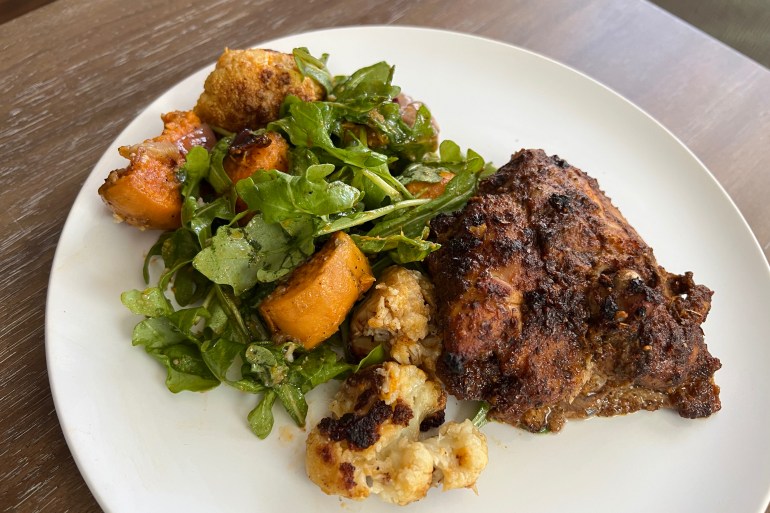
One-Pan Peruvian Chicken with Cauliflower and Sweet Potatoes | Recipe via Cook’s Country
One-Pan Peruvian Chicken with Cauliflower and Sweet Potatoes | Recipe via Cook’s Country
This study investigates inalienable possession in Spanish-English code-switching among US heritage speakers, using an acceptability judgment task (AJT) and an elicited production task (EPT). Results from both tasks show a clear rejection of the English definite determiner in switched contexts, and a strong preference for a preverbal clitic with Spanish verbs, particularly in the AJT. However, the tasks diverge in production patterns, with no clitic appearing in a third of the Spanish verb tokens in the EPT, suggesting flexible bilingual alignments and a greater prevalence of English possessive determiners in code-switching contexts.
Article published in Languages.
This study tests the acceptability of preposition stranding in the intrasentential code- switching of US heritage speakers of Spanish. Because languages vary when extracting determiner phrases from prepositional phrases, known as preposition stranding or p-stranding, a contrast arises for Spanish–English bilinguals. English allows p-stranding, but in Spanish the preposition is traditionally pied-piped with the DP. Heritage speakers of Spanish, though, have shown variability, with child sequential bilinguals requiring said pied-piping, but simultaneous bilinguals allowing p-stranding in Spanish. Participants (n = 24) completed a written acceptability judgment task with a 7-point Likert scale. The task included code-switched sentences (n = 16) with p-stranding, switching from either English to Spanish or vice versa, with comparison monolingual equivalents for Spanish (n = 8) and English (n = 8) included as well. The results found that the simultaneous bilinguals accepted p-stranding in both languages, while also showing no restriction in either code-switching condition. Child sequential bilinguals, however, showed the expected monolingual distinction between Spanish and English, and p-stranding was only accepted with Spanish determiner phrases extracted from an English prepositional phrase (i.e., Spanish-to-English). These findings support the previously reported differentiation between simultaneous and child sequential bilinguals regarding p-stranding, while expanding it to code-switching.
doi: 10.3390/languages7010045
 Bryan Koronkiewicz