
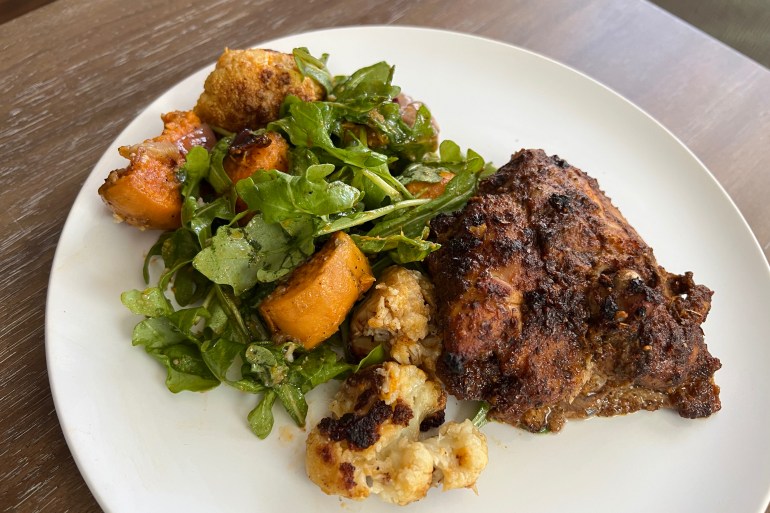
One-Pan Peruvian Chicken with Cauliflower and Sweet Potatoes | Recipe via Cook’s Country
One-Pan Peruvian Chicken with Cauliflower and Sweet Potatoes | Recipe via Cook’s Country
This study investigates inalienable possession in Spanish-English code-switching among US heritage speakers, using an acceptability judgment task (AJT) and an elicited production task (EPT). Results from both tasks show a clear rejection of the English definite determiner in switched contexts, and a strong preference for a preverbal clitic with Spanish verbs, particularly in the AJT. However, the tasks diverge in production patterns, with no clitic appearing in a third of the Spanish verb tokens in the EPT, suggesting flexible bilingual alignments and a greater prevalence of English possessive determiners in code-switching contexts.
Article published in Languages.
This study tests the acceptability of preposition stranding in the intrasentential code- switching of US heritage speakers of Spanish. Because languages vary when extracting determiner phrases from prepositional phrases, known as preposition stranding or p-stranding, a contrast arises for Spanish–English bilinguals. English allows p-stranding, but in Spanish the preposition is traditionally pied-piped with the DP. Heritage speakers of Spanish, though, have shown variability, with child sequential bilinguals requiring said pied-piping, but simultaneous bilinguals allowing p-stranding in Spanish. Participants (n = 24) completed a written acceptability judgment task with a 7-point Likert scale. The task included code-switched sentences (n = 16) with p-stranding, switching from either English to Spanish or vice versa, with comparison monolingual equivalents for Spanish (n = 8) and English (n = 8) included as well. The results found that the simultaneous bilinguals accepted p-stranding in both languages, while also showing no restriction in either code-switching condition. Child sequential bilinguals, however, showed the expected monolingual distinction between Spanish and English, and p-stranding was only accepted with Spanish determiner phrases extracted from an English prepositional phrase (i.e., Spanish-to-English). These findings support the previously reported differentiation between simultaneous and child sequential bilinguals regarding p-stranding, while expanding it to code-switching.
doi: 10.3390/languages7010045

Beale Street | Memphis, Tennessee
Article published in the International Journal of Bilingualism.
Using generative syntactic theory regarding verb raising, predictions are made about adverb position in intra-sentential Spanish– English code-switching. Since both languages allow for non-raising, pre-verbal adverbs should be acceptably switched. However, since verb raising is only available in Spanish, post-verbal adverbs should only be allowed with a Spanish finite verb.
Spanish–English early bilinguals (n=24) completed a written acceptability judgment task with a 7-point Likert-type scale. The Spanish–English code-switched sentences contained a finite verb switched with a post-verbal or pre-verbal adverb. In addition, comparison sets of monolingual equivalents were tested, targeting adverb order in Spanish and English.
A total of 192 judgments were included in the analysis, and z-scores of the mean ratings provided by the participants were calculated. After a descriptive analysis of the results compared language and adverb order, statistical analyses were conducted via analyses of variance (ANOVAs).
Participants showed a preference for non-raising in English, while they accepted both orders in Spanish, but only with adverbs of completion and manner. For code- switching, non-raising was always acceptable, but verb raising varied. The availability of switched non-raising directly follows from the literature. However, the language of the finite verb did not predict availability of verb raising in code-switching. The results suggest that the language of the adverb is crucial to the availability of switching, not solely the verb.
The status of adverbs in code-switching has been left relatively unexplored. This study provides important details regarding adverb position both in mixed Spanish–English utterances and in monolingual contexts for this particular bilingual population.
These findings have a broader impact by providing data about adverb-position preferences in Spanish for a different community of speakers. In particular, it shows even more variability in the idiosyncratic behavior of different adverbs in Spanish.
doi: 10.1177/13670069211057955

Mint Chocolate Cookies | Recipe via Milk Jar Cookies Bakebook
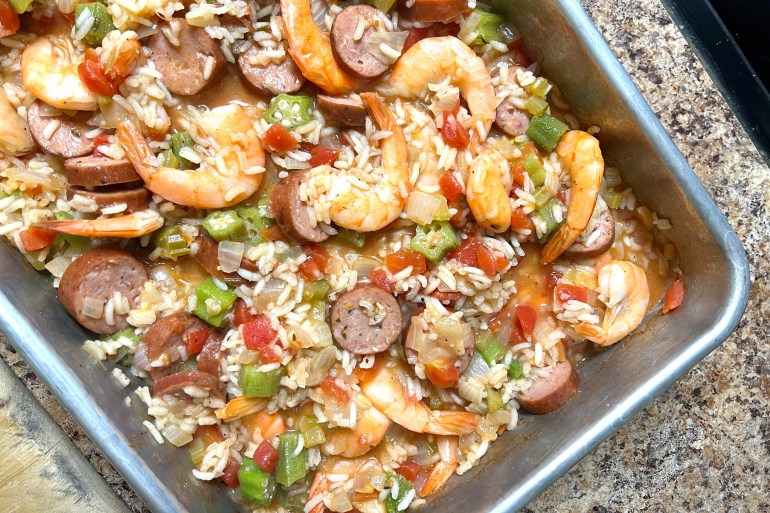
One-Pan Cajun-Style Rice with Andouille, Shrimp, and Okra | Recipe via America’s Test Kitchen

Aramón Formigal | Aragón, España

Casco Viejo | Bilbao, País Vasco, España

Punta Galea | Getxo, País Vasco, España
 Bryan Koronkiewicz